




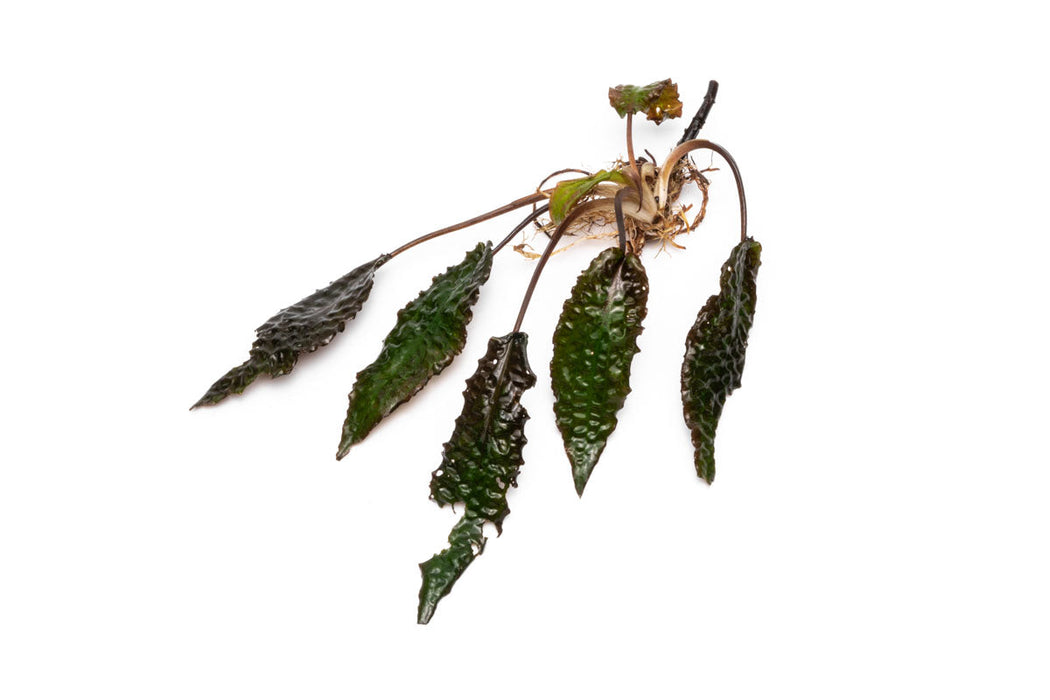
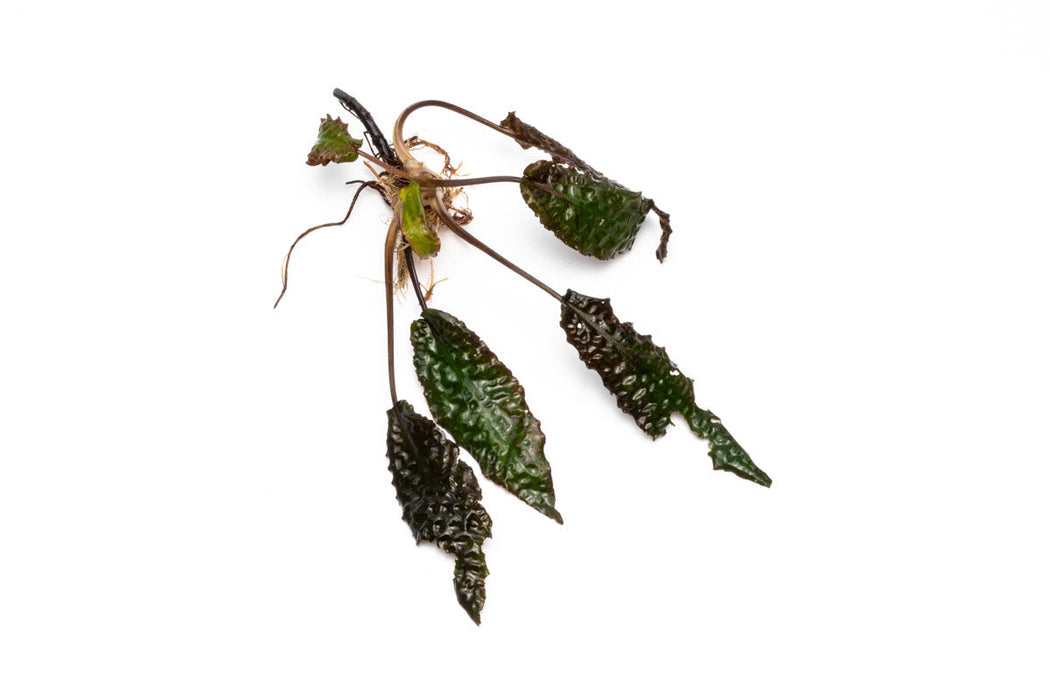
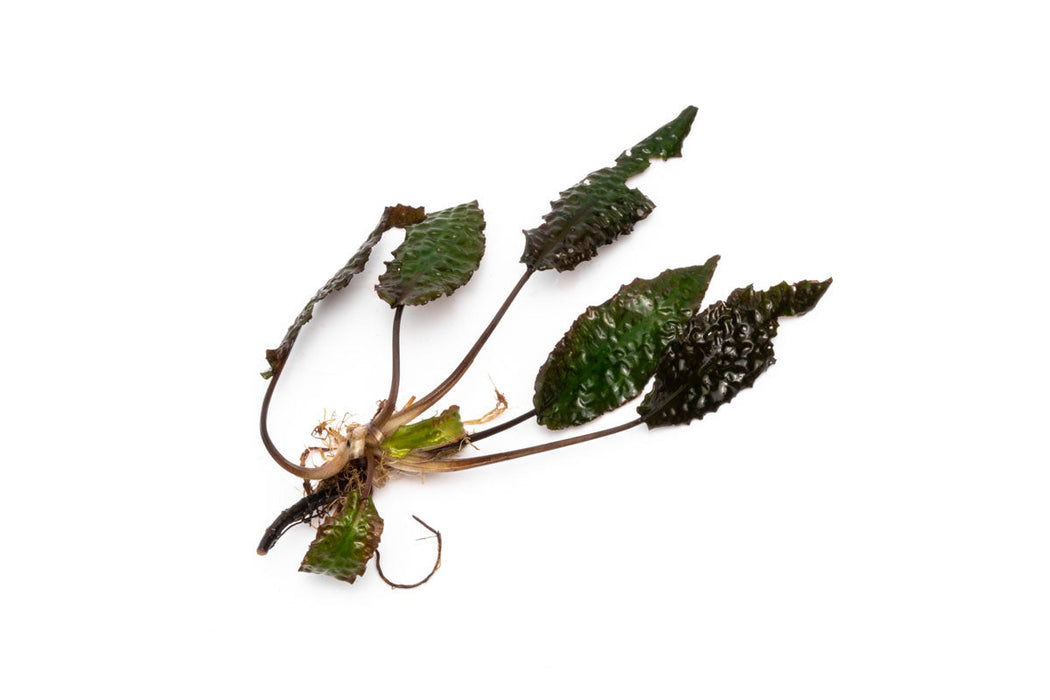
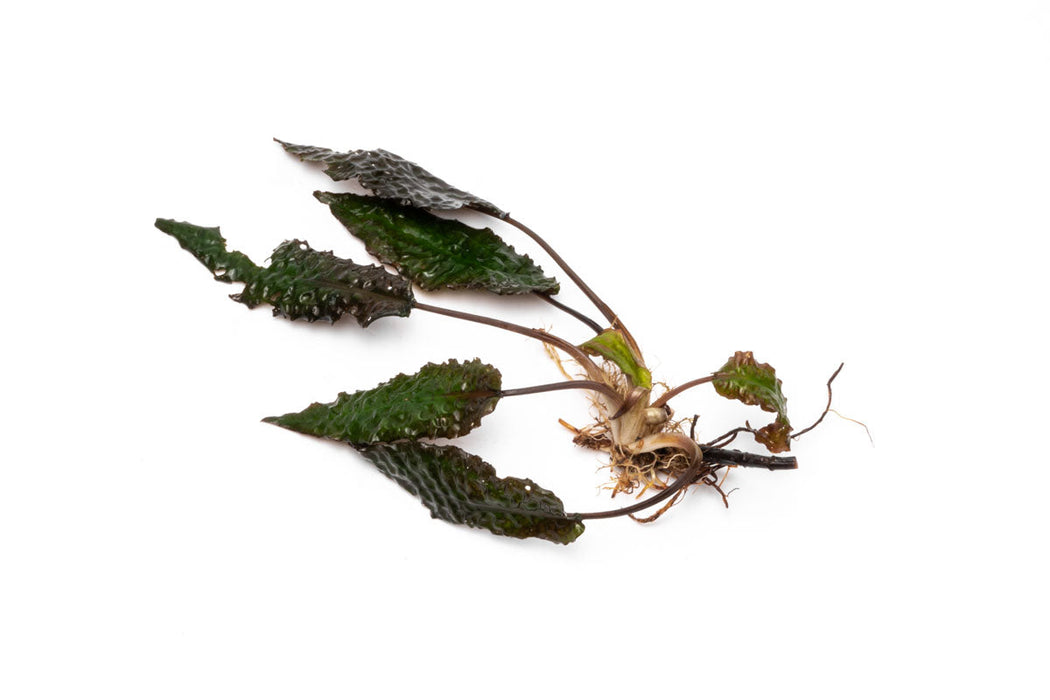
Cryptocoryne Striolata
Plant Profile
Cryptocoryne striolata doesn't need bright colors to catch your eye; its shape does all the talking! Native to the Sarawak region of Borneo, where it naturally clings to riverbed rocks and submerged tree roots, this uncommon species stands out with long, slender stalks topped by compact reddish-brown leaves. As with all crypt plants, this plant can be sensitive to changes in water parameters and doesn’t like to be moved. But once its extensive root system anchors into the substrate, its distinct silhouette and warm earthy tones will mature into a midground or background accent that plays beautifully against traditional green plants.
Key Features & Benefits
- Compact leaves on long petioles create an elevated focal point in midground or background zones.
- Can be grown emersed in high-humidity setups, where mature plants may produce flowering spathes above water.
Care & Planting Instructions
- Prep the plant by removing it from the pot and clearing all rockwool from the roots.
- Use fine-tip pinsettes to push roots deep into quality aquarium soil as Cryptocoryne species are heavy root feeders.
- Insert root tab fertilizers if using an inert substrate like sand or gravel to supply essential subterranean nutrients.
- Inject pressurized CO2 for faster growth, though not required for long-term health.
- Choose a permanent spot from day one; moving an established plant will likely trigger leaf loss.
- Cryptocoryne species can be grown emersed in high-humidity setups or submerged in aquariums. Propagate by splitting the rhizome or replanting new growth shoots.
- Don't discard the plant if leaves dissolve early on; see our guide to managing Cryptocoryne melt to help your plant recover smoothly.
Quick Facts
Listed information should be treated as general guidelines only. Team Buce Plant encourages you to do thorough research to ensure healthy growth!
| Attribute | Specification |
|---|---|
| Scientific Name | Cryptocoryne striolata |
| Common Name(s) | Crypt Striolata, Cryptocoryne Striolata |
| Family | Araceae |
| Plant Type | Rosette / Root Feeder |
| Height | 4–8" (10–20 cm) |
| Care Difficulty | Easy |
| Light Requirement | Low to Medium |
| CO2 Requirement | Optional (Accelerates growth and foliage density) |
| Placement / Usage | Midground / Background Accent |
| Growth Rate | Slow |
| Water Parameters | pH 6.0–7.5 | Temperature 72°F–82°F (22°C–28°C) |
| Propagation Method | Rhizome Division / Runner Offshoots |
| Origin | Borneo (Sarawak region) |
Frequently Asked Questions
1. Why are my Cryptocoryne Striolata leaves melting away?
Transplanting Crypts into new water parameters often triggers a temporary reaction where old leaves dissolve. As long as the root system remains undisturbed in healthy soil, fresh foliage will sprout shortly. Check out our guide on Cryptocoryne melt for step-by-step recovery tips.
2. Can I move my Cryptocoryne to a new spot in the tank later?
It is best to leave your Cryptocoryne permanently in its original spot. Uprooting an established plant damages its fine root hairs and almost always causes another cycle of leaf melt.
3. Should I use root tabs or liquid fertilizers for Cryptocoryne Striolata?
Root tabs are far more effective than liquid fertilizers for Cryptocoryne species because they draw the overwhelming majority of their nutrition through their roots. While liquid nutrients benefit water column feeders like mosses or stem plants, placing nutrient-rich root tabs inside sand or gravel substrates directly fuels your Crypt's foliage growth.