


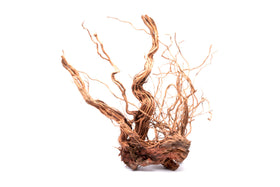


Java Fern on Nano Wood
Plant Profile
Java Fern on Nano Wood offers a convenient, pre-mounted hardscape accent designed to bring instant lush structure to smaller aquariums. Featuring classic broad green fronds pre-secured into a small piece of natural nano driftwood, this plug-and-play setup saves you the effort of tying or gluing individual plants while delivering classic epiphyte hardiness. Virtually bulletproof and unbothered by neglect, it rests effortlessly on your substrate or wedged between larger rocks. It is hands-down one of the best aquarium plants for beginners seeking convenience for nano scapes!
Key Features & Notes
- Tough, fibrous foliage easily withstands curious nipping from herbivorous fish like cichlids, goldfish, and large snails.
- Pre-attached to a small piece of natural nano wood, providing a compact, ready-to-drop hardscape accent tailored for nano tanks and tight spaces.
- Exceptional hardiness lets it thrive in non-CO2 tanks and low-light environments.
Care & Planting Instructions
- Prep the plant by rinsing the nano wood piece gently in clean freshwater to remove loose debris before placing it directly into your aquarium.
- Java Fern on Nano Wood is an epiphytic fern that comes pre-bound to hardscape; position the wood directly on top of your substrate or wedged between rocks, ensuring the horizontal rhizome remains exposed and unburied.
- Avoid making drastic changes to your water parameters or lighting because unstable conditions are the primary cause of leaf melt in new specimens.
- While this plant is hardy and low-maintenance in standard setups, gentle water movement and regular liquid fertilizing will yield much faster growth and broader fronds.
- Master long-term care and troubleshoot common leaf issues by checking out our Java Fern Care Guide.
- Final size and foliage pattern depend entirely on your specific aquarium conditions; please note that photos are a representation, and individual wood shapes and plant arrangements may vary.
Quick Facts
Listed information should be treated as general guidelines only. Team Buce Plant encourages you to do thorough research to ensure healthy growth!
| Attribute | Specification |
|---|---|
| Scientific Name | Microsorum pteropus (syn. Leptochilus pteropus) |
| Common Name(s) | Java Fern on Nano Wood, Java Fern Nano Driftwood |
| Family | Polypodiaceae |
| Plant Type | Epiphyte Pre-Attached to Nano Hardscape |
| Care Difficulty | Beginner / Easy (Low-Tech Compatible) |
| Light Requirement | Low to Medium |
| CO2 Requirement | Not Required (Beneficial) |
| Placement / Usage | Nano Foreground, Midground, Desktop Aquarium Accent |
| Height / Size | 3"–5" (7.5–13 cm) |
| Growth Rate | Slow to Moderate |
| Water Parameters | pH 6.0–7.5 | Temperature 68°F–82°F (20°C–28°C) |
| Propagation Method | Rhizome Division & Adventitious Plantlets |
| Origin | Indonesia |
Frequently Asked Questions
1. Why are there small black spots and tiny leaves growing under my Java Fern leaves?
Do not panic; your plant is not diseased! Java Fern reproduces naturally through adventitious plantlets. Small dark bumps (sporangia) form along the undersides of mature leaves, sprouting tiny brown roots and mini green fronds. Once these baby plantlets develop 3–4 leaves, you can gently pop them off the mother leaf and glue them elsewhere in your aquarium.
2. Can I remove the Java Fern from the nano driftwood?
Yes. The plant is secured into a small cavity on the wood piece. If you prefer to detach it later, you can gently pull the roots free and re-attach or glue the rhizome onto another hardscape feature in your tank.
3. Can I bury the nano driftwood piece in substrate?
You can rest the wood on top of your substrate or bury the bottom portion to anchor it, but the green rhizome of the Java Fern must remain completely above the substrate line. Burying the rhizome beneath gravel or sand will suffocate it, causing the plant to rot.
4. Will fish like cichlids or goldfish eat Java Fern on Nano Wood?
Generally, no. Java Fern leaves are thick, fibrous, and contain bitter-tasting compounds that deter most plant-eating fish. Because the plant is already anchored to a piece of hardscape, energetic fish are also less likely to uproot or displace it.